
Built from testing practice, not from a software feature list.
Rulint is a founder-led independent compliance testing company created to bring disciplined enterprise testing methodology to financial-services organizations without recreating the bureaucracy of a large institution.
Compliance programs need a credible way to prove whether they work.
Policies, procedures, monitoring, dashboards, and control inventories are important, but they do not by themselves establish that a compliance process operated as required.
Rulint was built around the independent testing question: define what should happen, determine the appropriate population and evidence, execute the test, resolve exceptions, complete quality review, and deliver a conclusion that can be traced back to its basis.
More than two decades inside enterprise financial services.
Rulint's methodology is informed by more than two decades of financial-services experience, including independent testing, test development, methodology, governance, evidence evaluation, and defensible reporting.
That experience shapes both the testing service and the technology supporting it: methodology before execution, population governance, documented testing judgment, quality review, and preserved evidence.
Peter brings more than two decades of enterprise financial-services experience spanning independent testing, test development, methodology, governance, evidence evaluation, quality review, and defensible reporting. He founded Rulint to bring that testing discipline to organizations without requiring them to recreate a large-bank testing infrastructure.
Independent Testing
Evaluating whether financial-services processes, controls, and regulatory requirements operated as expected rather than relying solely on management assertions or monitoring results.
Test Design & Methodology
Translating requirements into testing objectives, populations, test questions, evidence expectations, exception criteria, calculation methods, and defensible reporting logic.
Population & Evidence Governance
Establishing confidence in what is being tested by reviewing population-generation methods, required data, sampling approaches, evidence sufficiency, and testing lineage.
Findings, QA & Reporting
Distinguishing factual clarification from testing judgment, resolving exceptions, completing quality review, and documenting conclusions that can withstand challenge.
The methodology extends beyond the platform.
Rulint's approach to compliance testing is also reflected in published practitioner work focused specifically on the discipline of financial-services compliance testing.
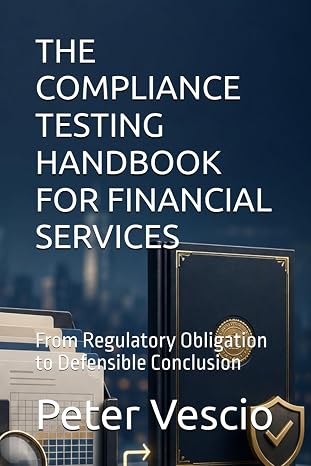
The Compliance Testing Handbook for Financial Services
Written by Rulint founder Peter Vescio, the handbook examines the discipline of translating compliance requirements into structured testing methodology, evaluating populations and evidence, documenting exceptions, and reaching conclusions that can be supported and defended.
The book and Rulint share the same underlying principle: a compliance conclusion is only as credible as the methodology, evidence, and testing record supporting it.
Early Rulint engagements stay close to the methodology.
Founder-led does not simply mean having a founder on sales calls. It means the person shaping Rulint's testing methodology and product remains directly connected to how engagements are scoped, executed, reviewed, and improved.
Direct Methodology Oversight
Testing design and execution standards remain closely connected to the methodology behind the service.
Fast Escalation
Questions involving scope, evidence, exceptions, or testing judgment do not need to travel through layers of organizational bureaucracy.
Product Feedback Loop
Real engagement experience directly informs how Rulint's workflows, controls, reporting, and client experience continue to develop.
Accountability
The quality of the testing methodology, client experience, and resulting work product remain directly connected to Rulint leadership.
Rigor comes from methodology and evidence, not complexity for its own sake.
Methodology Before Execution
Define the testing objective, population, evidence expectations, decision logic, and exception criteria before producing results.
Technology Supports Judgment
Automation and AI can improve structure, analysis, consistency, and efficiency. They do not replace governed testing judgment.
Every Conclusion Needs a Basis
A defensible result should remain connected to the requirement, methodology, population, evidence, exceptions, review history, and decisions supporting it.
Bring enterprise testing discipline to organizations that need the rigor, not the bureaucracy.
Rulint combines independent testing expertise with purpose-built technology so financial-services organizations can obtain structured, evidence-based testing without building a large internal testing infrastructure around every engagement.
What needs to be independently evaluated?
Start with the compliance requirement, control, process, program, product, or population that needs independent testing. Initial scoping does not require confidential client data.